
Blockbuster Skies, Back-to-School Begins, & Being Present!

.png)
Blockbuster Skies, Back-to-School Begins, & Being Present!
August is summer’s blockbuster month full of exciting celestial coincidences. August 12th brings a once-in-a-generation doubleheader event — a total solar eclipse and the Perseids meteor shower all in one day (a cosmic coincidence if you will)— and Slooh is hosting not one, but two Global Star Parties to witness it together. We will kick the day off at 12:15pm ET with the Total Solar Eclipse Star Party and then celebrate again at 7pm ET for The Perseids: Shooting Stars in a Moonless Sky Star Party!
We're also thrilled to welcome COSI, the #1 Science Museum in the Country, as our newest partner (see our spotlight below), and to share two upcoming webinars with St. Vrain Valley Schools and Dr. Moriba Jah as Back-to-School season kicks off (details coming soon).
With Fall on the horizon in the northern hemisphere, we know the summer nights are numbered. Before the schedules fill back up and classes or work gets stressful, take a moment to step outside, look up, and soak in what's left of the long warm evenings. It's often in these in-between moments… the tail end of a vacation, the last quiet mornings before the alarm goes back on, the pause before your next chapter of school resumes…that we reflect the most, breathe the deepest, and remember what actually matters. The night sky has a way of meeting you there.
See you all in September, actually see you on August 12th at our star party!
Total Solar Eclipse Global Star Party — Aug 12, 2026 1PM ET
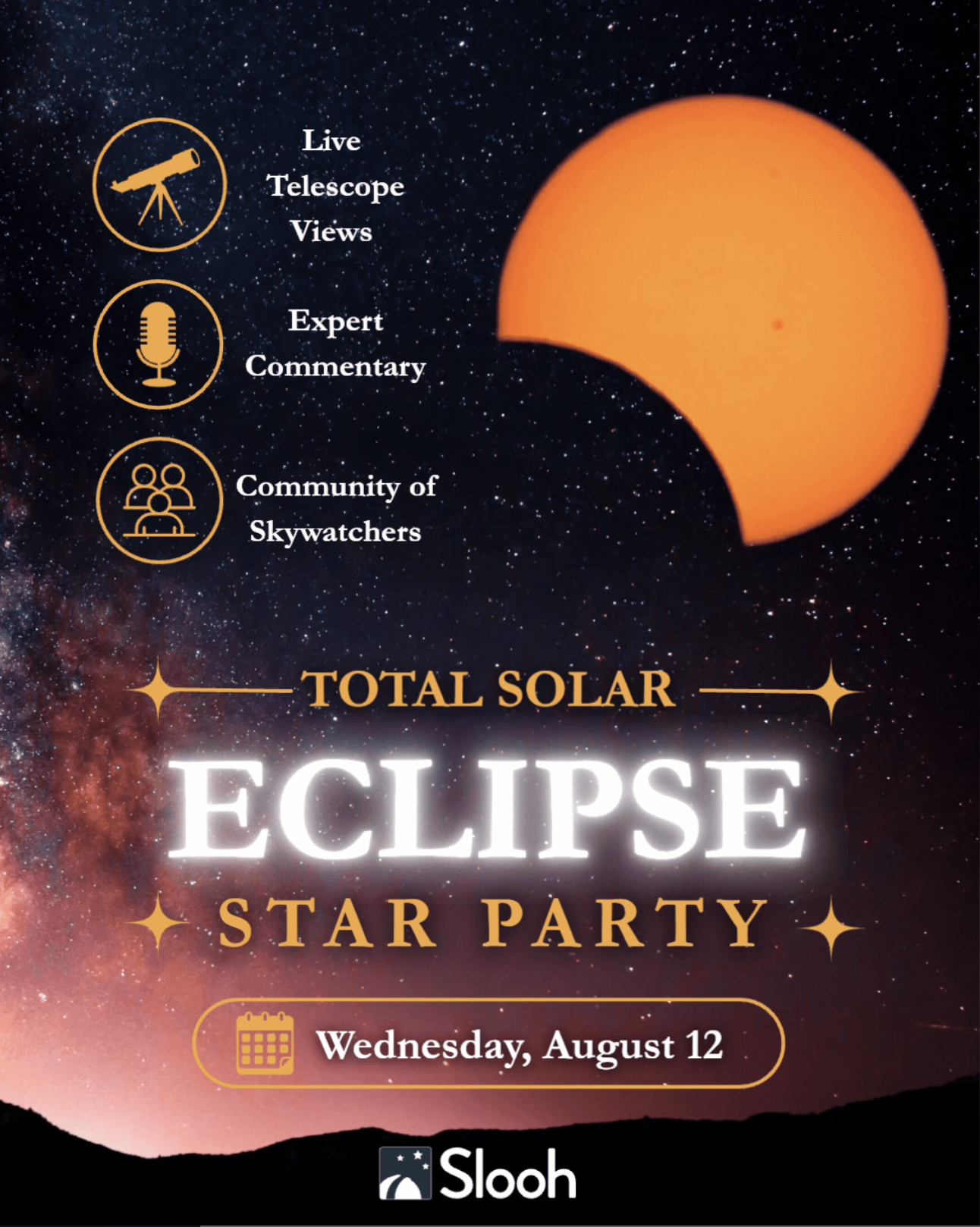
Join Slooh's Global Star Party on the afternoon of August 12 for a once-in-a-generation celestial event, Total Solar Eclipse 2026, as the Moon's shadow sweeps across the Arctic, Greenland, Iceland, and northern Spain in the first total solar eclipse visible from mainland Europe since 1999.
Live broadcast begins:
🕐 9:30 AM PDT | 12:30 PM EDT | 16:30 UTC
A total solar eclipse is already one of nature's rarest spectacles. But the 2026 eclipse arrives at a remarkable moment, crossing two of the world's most dramatic landscapes, Iceland and northern Spain, and bringing totality to a continent that hasn't seen it in 27 years. Across much of Europe, observers will witness a deep partial eclipse, with the Moon covering up to 91% of the Sun in London, 92% in Paris, 86% across Germany, and 99% in Madrid. But inside the narrow path of totality, something far more extraordinary unfolds.
For just a minute or two, day becomes night. The corona blazes into view. Temperatures drop, stars appear in the afternoon sky, and the diamond ring effect lights up the horizon. People who have seen totality describe it as unlike anything else in their lives.
🌑 WHAT TO EXPECT
We'll follow the Moon's shadow as it races across the Atlantic and into the heart of Spain. Slooh will share live feeds from along the eclipse path, bringing you real-time views of the corona, Baily's beads, and the diamond ring effect as the Moon slides across the face of the Sun. Expert commentary and eclipse science throughout.
For most people watching from Europe, this will be a once-in-a-lifetime event. Iceland hasn't seen a total solar eclipse since 1954. The next one visible from mainland Europe won't come until 2081.
Members can watch on the Star Party page or join the interactive Zoom. Everyone can tune in live on Slooh's social channels. Add event to your calendar!
Your August Skywatching Guide
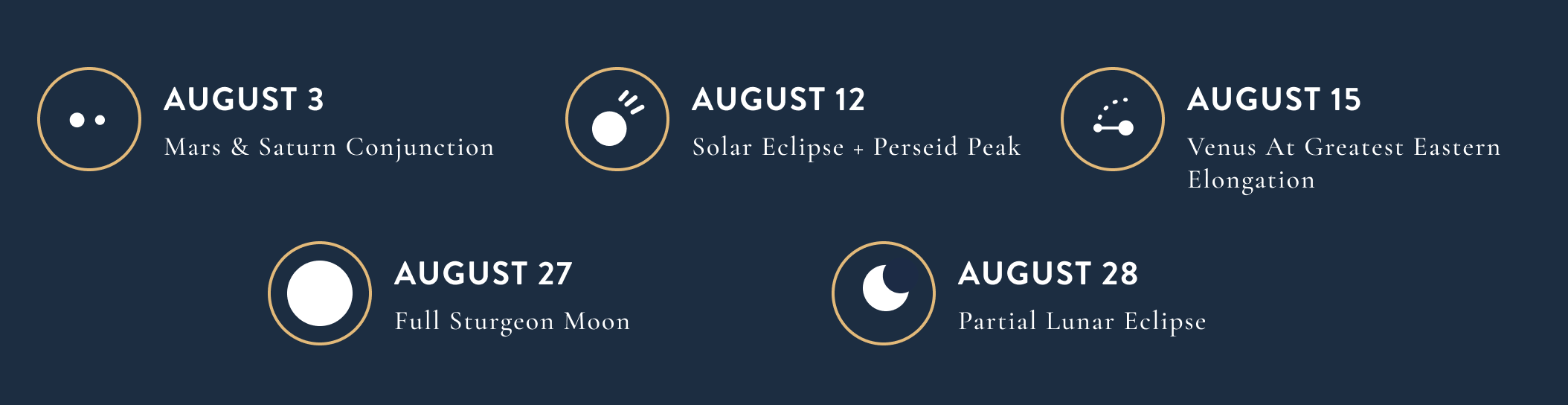
August 3 | Moon and Saturn Conjunction
The waning gibbous Moon swings close to Saturn in the pre-dawn sky — a beautiful naked-eye pairing and a gentle preview of Saturn's growing prominence heading into October opposition. The rings have been tilting back toward Earth all year and are looking better every week. A great reason to schedule a mission.
August 12 | Total Solar Eclipse + Perseid Peak
The most stacked single day in astronomy this decade. During the day, totality sweeps through Iceland and northern Spain. After dark, the Perseids peak under the darkest skies of the year with zero moonlight. See the Star Party section above — and plan ahead.
August 15 | Venus at Greatest Eastern Elongation
Venus reaches its farthest point from the Sun in the evening sky — its highest and most brilliant position of the entire year. At 45.9 degrees of elongation, it blazes in the west after sunset and is simply unmissable. This is the ideal moment to schedule a mission and catch Venus's dramatic crescent phase through the telescope.
August 27 | Full Sturgeon Moon
August's Full Moon carries the traditional name Sturgeon Moon, honoring the time of year when Indigenous peoples of the Great Lakes knew the giant fish ran thick in the water. Members can capture it and explore the history behind the name with the Sturgeon Moon 2026 Quest.
August 28 | Partial Lunar Eclipse
Two weeks after the total solar eclipse, the Moon passes through Earth's shadow one more time. A noticeable portion enters the darker umbral shadow, visible from the Americas, Europe, and Africa. No eye protection needed — just look up. A quiet and beautiful close to an extraordinary month.
Want to observe these events LIVE? Log in to Slooh and explore!
August Quest Guide 📚🌌🔭
As summer begins to wind down in the Northern Hemisphere, August offers warm evenings, rich views of the Milky Way, and exciting opportunities to explore the Sun, stars, and the vast scale of the Universe. Here are some Quests to help students make the most of August's skies.
🐟 Under the Sturgeon Moon: August's full moon takes center stage in the Sturgeon Moon 2026 Quest, where Members discover the history behind this seasonal lunar name and capture the full moon on August 27, 2026. This Quest is a fun way to connect the changing seasons with the traditions that have linked people to the night sky for centuries.
💥 The Biggest Stars Go Out with a Bang: In the Out With a Bang Quest, Members investigate the dramatic lives of high-mass stars. By capturing stars at different stages of evolution, you will discover how these stellar giants end their lives in spectacular supernova explosions and compare their life cycles to those of stars like our Sun.
☀️ Watching Our Dynamic Sun: The Our Rotating Star Quest gives Members a front-row seat to our nearest star using Slooh's Canary Five Solar Telescope. By observing the Sun in hydrogen-alpha light, they'll create a time-lapse animation of solar activity while exploring sunspots, prominences, the Sun's 11-year activity cycle, and the space weather that can affect Earth.
🚀 A Journey Across the Universe: The How Far Quest takes Members on an incredible voyage from our Solar System to the edge of the observable Universe. Along the way, they'll capture celestial objects across Slooh's three observing domains and develop a deeper appreciation for the immense distances that separate the objects we see in the night sky.
🌌 Discover Our Galactic Home: In the Milky Way Explorer Quest, Members capture seven spectacular objects within our home galaxy, including nebulae, star clusters, and individual stars. As they build their collection, they'll uncover the stories behind these celestial wonders and learn how they shape the Milky Way.
🌊 Engineering Earth from Space: The Dam Detectives Quest uses Sentinel-2 satellite imagery to investigate some of the world's largest dams. Members explore how hydroelectric power works, examine the environmental and societal impacts of dam construction, and discover how satellites help scientists monitor changes to Earth's surface.
These Quests are a fantastic way to close out the summer (or winter, if you're in the Southern Hemisphere) by exploring everything from our own Sun to the farthest reaches of the Universe—while discovering how both telescopes and satellites help us better understand our place in the cosmos.
Spotlight
Partner Spotlight: COSI
We're thrilled to spotlight and welcome COSI — the Center of Science and Industry in Columbus, Ohio, and the #1 Science Museum in the Country for five consecutive years — as Slooh's newest partner. Starting August 5th COSI members now receive complimentary access to Slooh's Observer membership tier, connecting them to our global network of robotic telescopes in the Canary Islands, Chile, and Australia.
The partnership unites two organizations with a shared commitment to making science accessible. COSI, which has spent more than 60 years engaging, inspiring, and transforming lives and communities through hands-on science learning, will extend that mission beyond its walls through Slooh’s global telescope network.
“The universe belongs to everyone, and this partnership with COSI brings that belief to life for families and students across Central Ohio and beyond. When a child in Columbus can point a telescope in the Canary Islands at the Orion Nebula and see it with their own eyes, that’s the kind of transformative experience that sparks a lifelong connection to wonder and science.”
— Dr. Emma Louden, President, Slooh
“At COSI, we believe science should feel personal, participatory, and within reach for every learner. This partnership with Slooh gives our members the chance to do more than simply learn about space. They can actively explore it, investigate it, and connect with the universe in a meaningful and memorable way.”
— Chad Thompson, Chief Operating Officer, COSI
Featured Slooh 1000
The Slooh 1000 is our curated list of the 1,000 most spectacular objects in the night sky — and a challenge to observe them all.
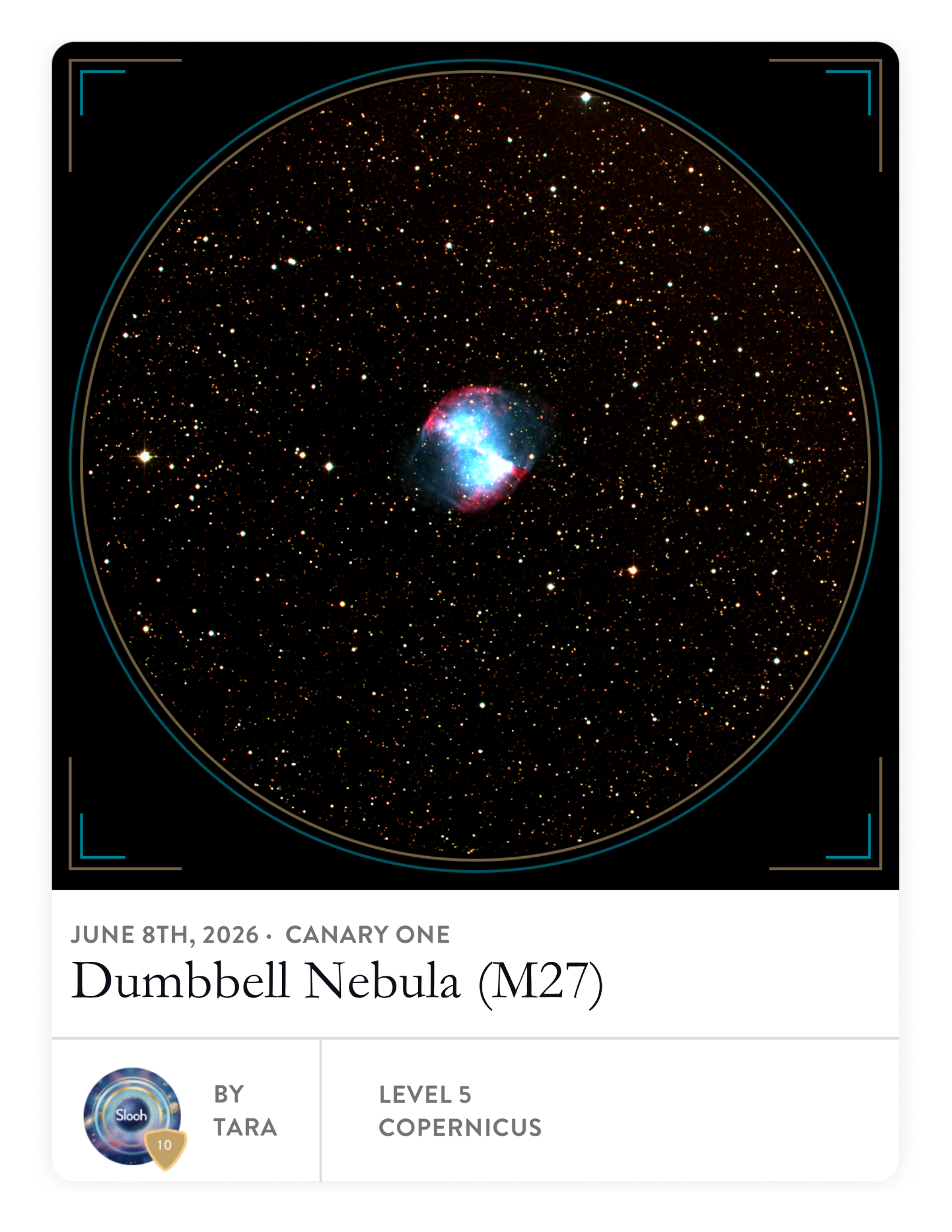
The Dumbbell Nebula (M27)
First observed by Charles Messier in 1764, it was the first planetary nebula ever discovered and he added it to his catalog as Messier 27. It shares a similar structure to many planetary nebula, containing dense knots of dust and gas. The white dwarf star at M27's center is one of the largest yet discovered.
Schedule your own mission now→