Springtime, Satellites, & Sharing the Sky

Updated: Mar 27
Spring has arrived, and April is giving us so much to celebrate on Earth and up in the sky. On the ground, we're celebrating both Earth Day alongside our partners at SkyFi and Celestial Buddies, as well as International Dark Sky Week alongside our partners at DarkSky International, who will join us for a special Star Party. And overhead, the Pink Moon rises, the Lyrids peak, and galaxy season opens wide. It's astronomy month, and there's no better time to be a Slooh member.
_________________________________________________________________________
Slooh Sharing
Observe. Share. Earn.
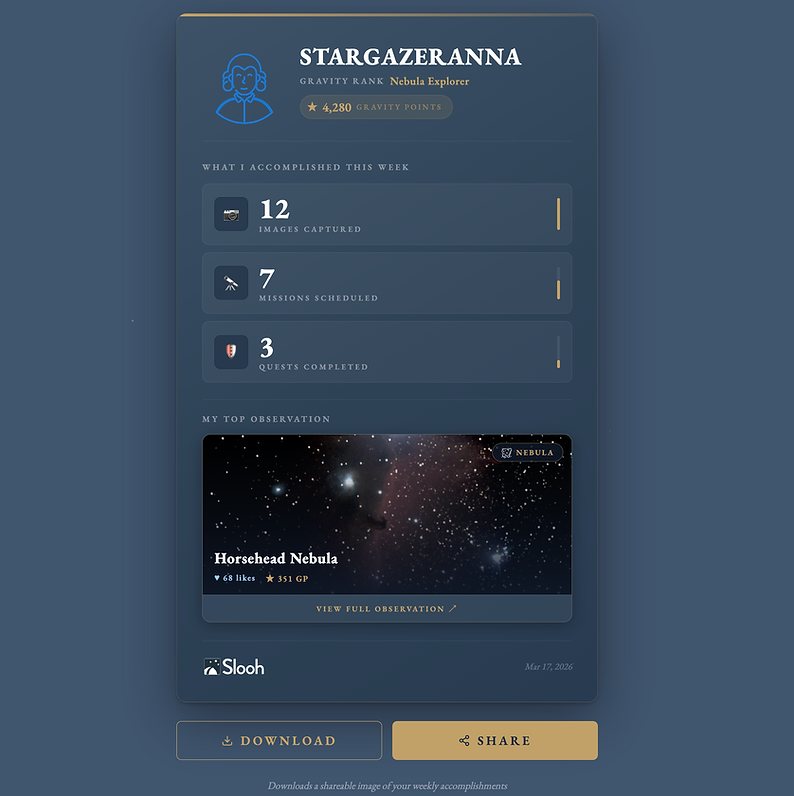
From weekly observation challenges to Gravity Points for social sharing, Slooh is more rewarding when you bring others along. And this spring, your progress has never looked better. Every Sunday, your Weekly Digest email arrives with a snapshot of your progress (see below) ready to share with the world.
Your Slooh weekly progress card is waiting!
Members:
🃏 Every Sunday, your Weekly Digest lands with a personalized snapshot of your progress: missions, gravity points, your best observations. This spring, we're making it shareable. Check your inbox this Sunday.
Non Members:
🔭 Want to see your own card? Slooh members get a personal progress card every week, tracking their observations, gravity points, and journey across the night sky. Ready to start yours? Join Slooh →
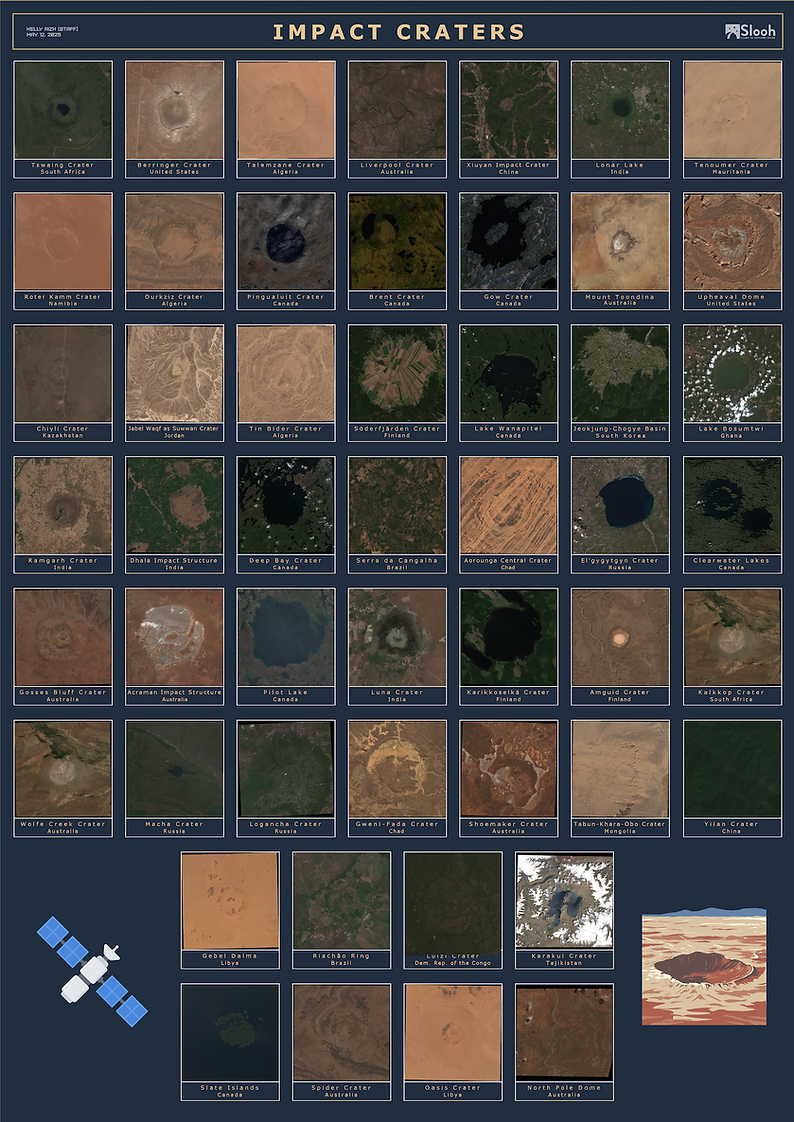
Sharing your Earth Day through the Slooh Satellites

What does your favorite place on Earth look like from space? In honor of Earth Day, Slooh's satellites, in partnership with SkyFi, are turning the lens back on our planet.
Share your favorite parts of Earth through our satellites this Earth Day and show the world what home really looks like from above. Login & schedule your satellite mission right now!
_________________________________________________________________________
Your April Skywatching Guide
April 2 | Full Pink Moon
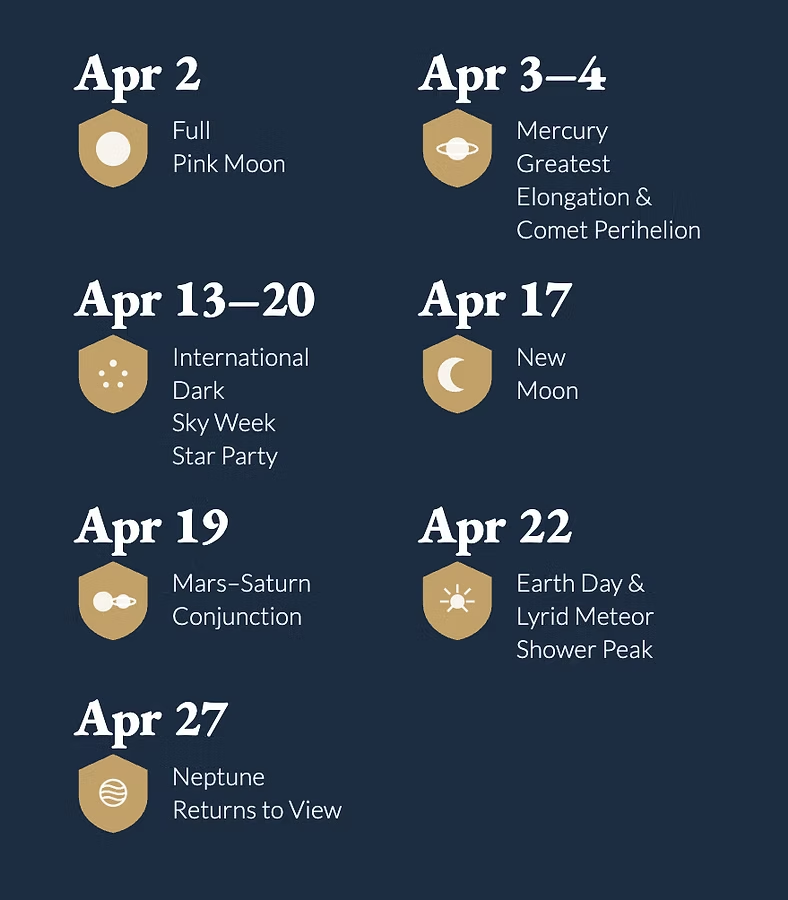
April's Full Moon rises in Virgo and carries the traditional name Pink Moon — not because it turns pink, but because it marks the first bloom of moss pink (wild phlox), one of spring's earliest wildflowers. It's also known historically as the Sprouting Grass Moon, Egg Moon, and Fish Moon.
For Slooh members, it's a perfect evening to capture the Moon in high detail, or to pair a lunar mission with bright nearby objects — look for the blue-white star Spica shining just over a degree away on the night of April 3rd.
April 3–4 | Mercury at Greatest Elongation + Comet Perihelion
A double-header to start the week. Mercury reaches its greatest angular distance from the Sun, making this the best opportunity to spot Mercury in all of 2026 — a planet that most skywatchers have never actually seen because it so rarely pokes far enough above the horizon. Look low in the eastern sky about an hour before sunrise with binoculars. On the same day, Comet MAPS reaches perihelion. Watch closely.
April 13–20 | International Dark Sky Week Star Party with DarkSky International
Slooh joins DarkSky International for a special members Star Party (April 3rd) in honor of International Dark Sky Week, the annual global movement to protect the night sky from light pollution. We're delighted to welcome Ruskin Hartley (CEO & Executive Director ) from DarkSky International as our featured guest. Together, we'll explore the science of light pollution, what it costs us as a civilization and an ecosystem, and how amateur astronomers and educators can take action.
This is a conversation about why the night sky matters. We'll be observing live through Slooh's telescopes, discussing dark sky preservation, and celebrating the profound importance of darkness itself.
📺 Members can join the interactive Zoom webinar and submit questions directly.
April 17 | New Moon
The Moon goes dark on the 17th, leaving the deepest, blackest skies of the month. This is prime time to schedule deep-sky missions: galaxies, nebulae, and star clusters pop against the darkness. If you've been waiting for the right night to chase a faint target, this is it.
April 19 | Mars–Saturn Conjunction
Reddish-orange Mars and pale-ringed Saturn converge in Cetus, separated by just over 3 degrees. You can observe both with the naked eye or binoculars, but a telescope will let you compare their color contrast side by side. On April 20th, Mercury joins the party, creeping within half a degree of Saturn, a genuinely tight pairing that's worth an early alarm.
April 22 | Earth Day + Lyrid Meteor Shower Peak + Celestial Buddies
The biggest date on the April calendar packs three celebrations into one night. The Lyrid Meteor Shower peaks on Earth Day, April 22nd, offering up to 10–20 meteors per hour under good conditions. The waxing crescent Moon sets early enough to leave dark skies during the best viewing hours (after 10 PM local time). The Lyrids radiate from the constellation Lyra, the higher it climbs, the more meteors you'll see.
It's also the perfect night to celebrate with our Celestial Buddies partnership! Whether you're looking up or looking at your shelf, tonight honors our connection to the cosmos.
For the classroom, this is a powerful Earth Day tie-in: the night sky belongs to Earth too. Light pollution, meteor showers, and orbital mechanics are all part of what it means to be a planet. Stay tuned for a potential giveaway on socials...
April 27 | Neptune Returns to View
Neptune becomes visible again in the pre-dawn sky this week, climbing above the horizon before sunrise in the constellation Pisces. At magnitude +7.8, it requires binoculars or a telescope to spot, but Slooh makes it easy. Neptune is often overlooked, but tracking the outermost ice giant is a rewarding mission for members building their Solar System observation log.
Honorable Mentions
Venus is a dominant presence in the evening sky all month long, blazing in the west after sunset. It's impossible to miss and a beautiful target for beginner missions. Schedule frequently — this apparition gets even better as spring progresses.
Jupiter continues to fade from its January opposition but is still visible in the early evening sky in Gemini. Catch it alongside the crescent Moon on the night of April 22nd, the two will appear less than 3.5 degrees apart.
_________________________________________________________________________
🐰April Quest Guide🌌🔭

April nights bring the galaxies of spring into full view. As the constellation Virgo climbs high in the sky, it opens a window into one of the richest regions of the Universe. Here are five Quests that make the most of April’s galaxy-filled skies.
🌷 Sprouting of the Pink Moon: April begins with the Pink Moon 2026 Quest, where members explore the history and meaning behind April's full moon and capture it themselves on April 1, 2026. To be ready for this event, start scheduling missions on March 26, 2026.
✨ The Maiden of the Zodiac: In the Myth of Virgo Quest, students explore the story behind one of the zodiac’s most prominent constellations. Along the way, they’ll learn about Bayer designations and the mythology associated with Virgo while capturing the constellation’s brightest stars with Slooh’s telescopes. Because Virgo reaches midnight culmination this month, April is the perfect time to build the constellation one star at a time.
🌌 A City of Galaxies: The Virgo Cluster Challenge Quest takes members on a tour of the nearest major galaxy cluster to the Milky Way. Located about 50–60 million light-years away, the Virgo Cluster contains thousands of galaxies packed into a vast cosmic metropolis. In this Quest, members capture 21 different member galaxies—including spiral, elliptical, and lenticular systems—creating their own gallery of one of the most scientifically important regions in the nearby Universe.
🌠 How Bright is the Sky Above Us?: In the How Bright is Space Quest, members investigate how astronomers measure brightness using the apparent magnitude system. They’ll compare the brightness of human-made satellites to stars, clusters, nebulae, and galaxies captured with Slooh’s telescopes. Along the way, students explore how the rapidly growing number of satellites is changing the night sky and consider the challenges of light pollution in space.
🛰️ Two Telescopes, One Universe: In the Slooh to JWST Quest, members capture three objects that have also been imaged by the James Webb Space Telescope. Along the way, they learn how Slooh’s ground-based telescopes and JWST’s space-based observatory complement one another—each with its own strengths—showing how modern astronomy is built on collaboration.
Spotlight

Our spotlight this month is on the top college classes in the Gravity Awards! The Gravity Awards honor the rare explorers whose skill, curiosity, and dedication have left a measurable pull on the Slooh Universe. Together, our growing gravity is expanding Slooh’s reach — measured not just in points, but in the collective impact of a community dedicated to exploration.
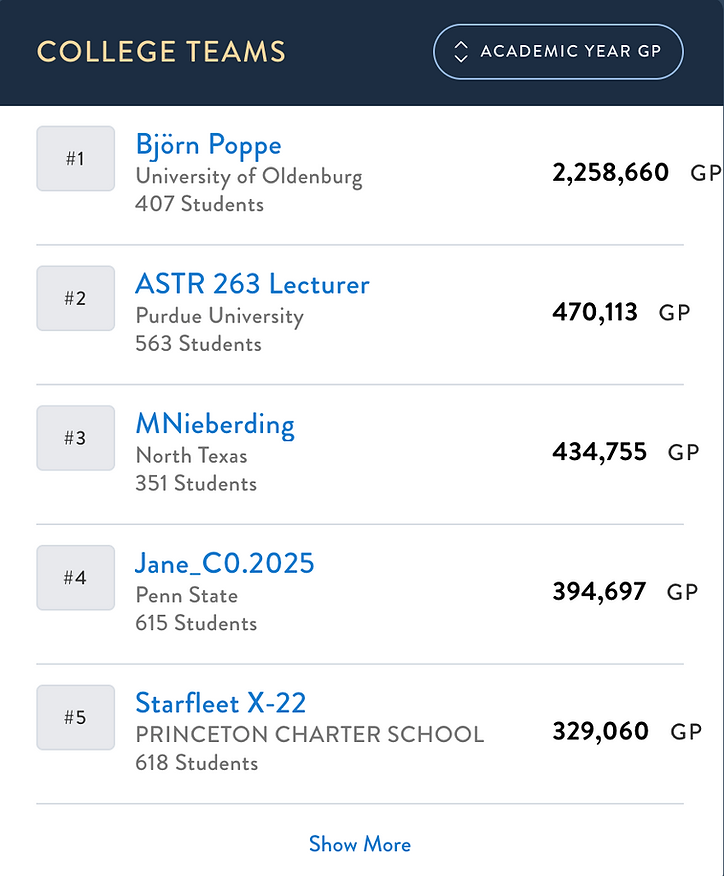
Our top five Gravity Point earning college classes are from University of Oldenburg, Purdue, University of North Texas, Penn State, & Princeton Charter! We can't wait to see how the leaderboard changes as the Spring semester progresses. Keep your eye on it and follow along here.
You can also track individual students who are crushing it as well as High School and K-8 classrooms!
Featured Slooh 1000

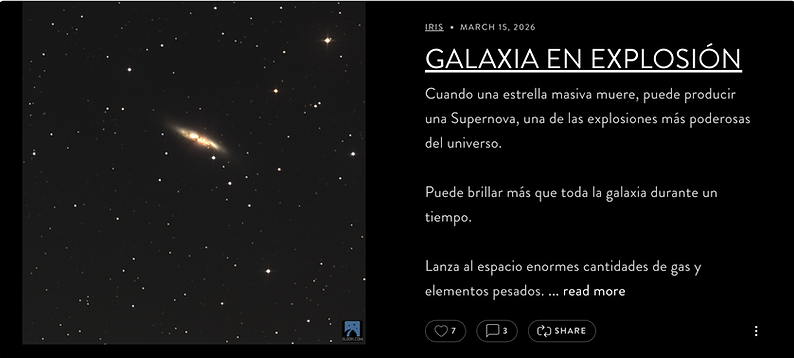
April is "Galaxy Season!" The Exploding Galaxy (M82) and the Pinwheel Galaxy (M101) are well placed and always look terrific this time of year.
M82: A close encounter with neighboring M81 has distorted the disk of M82, transforming it into a starburst galaxy, the closest one to us. In the center of the galaxy, stars are being born 10 times faster than in the entire Milky Way, making M82 extremely luminous. It also hosts other unusual objects, including the brightest pulsar ever detected.
M101: The brightest member of the M101 Galaxy Group, M101 is a face-on spiral galaxy roughly the size of the Milky Way. It is noteworthy for the unusually large number of bright star-forming regions present in the galaxy, more than 1200. M101’s asymmetrical shape and well-defined spirals are due to interactions with 5 smaller companion galaxies.
_________________________________________________________________________
Not yet a Slooh member? Learn more about our monthly memberships and sign up at slooh.com!