
What’s Overhead Matters: Slooh Welcomes Dr. Moriba Jah and Brings Space Domain Awareness to the Platform
.png)
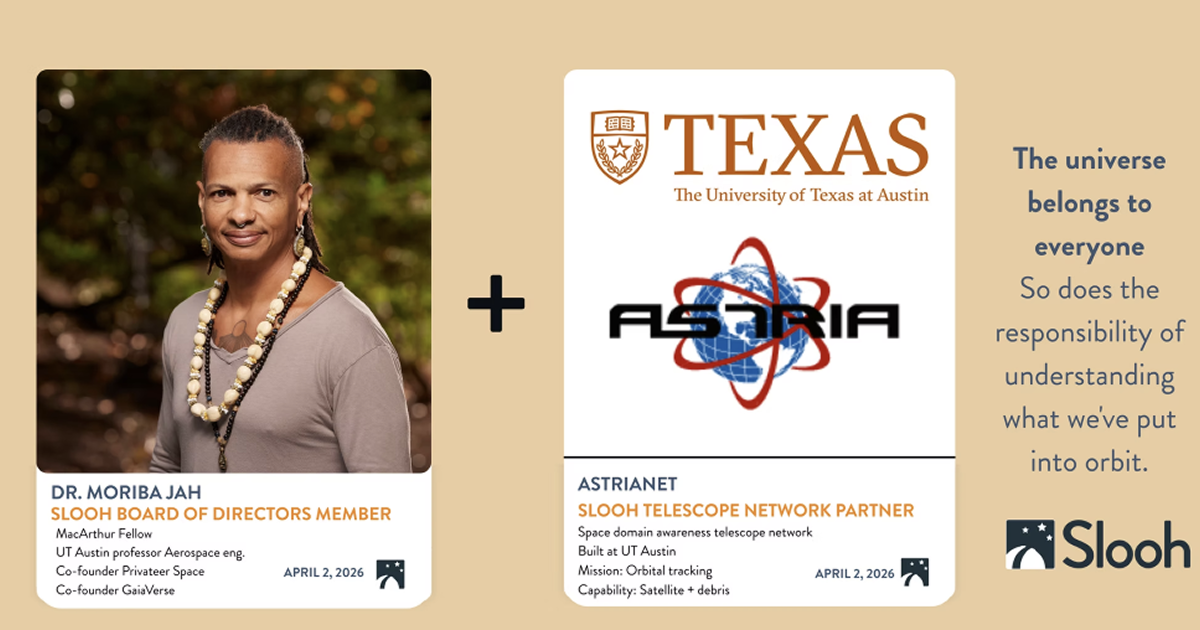
Since Slooh’s founding, our mission has been built on a simple conviction: the universe belongs to everyone. Our telescopes in Chile, Australia, and the Canary Islands have given hundreds of thousands of people direct, real-time access to the night sky—to galaxies, nebulae, planets, and the quiet wonder of looking up.
Today, we’re expanding what “looking up” means.
I’m thrilled to announce that Dr. Moriba Jah—one of the most important thinkers working at the intersection of space science, sustainability, and public understanding—has joined Slooh’s Board of Directors. And alongside his appointment, Slooh and The University of Texas at Austin have signed an agreement to integrate ASTRIANet, Dr. Jah’s telescope network for space domain awareness, into the Slooh platform.
The sky is more crowded than you think
There are more than 10,000 active satellites orbiting Earth right now. Add in defunct satellites, spent rocket stages, and the estimated 100 million pieces of debris, and you begin to see the scale of the challenge. Every one of those objects is moving at thousands of miles per hour. Many of them are visible from the ground. And understanding what they are, where they’re going, and what risks they pose has become one of the defining challenges of our era in space.
This field—space domain awareness—has historically been the province of governments, militaries, and defense contractors. The data was classified. The telescopes were restricted. The public was, by and large, left out of the conversation.
Dr. Moriba Jah has spent his career changing that.
Who is Dr. Moriba Jah?
It’s hard to do justice to Moriba’s career in a few paragraphs. He’s a MacArthur Fellow—the so-called “genius grant.” A full professor at UT Austin. A former researcher at NASA’s Jet Propulsion Laboratory and the U.S. Air Force Research Laboratory. He co-founded Privateer Space with Steve Wozniak to build tools that track objects in orbit, and GaiaVerse, a B-corp focused on planetary stewardship. He’s testified before Congress. He’s served on the U.S. delegation to the UN Committee on the Peaceful Uses of Outer Space. He co-edited the first comprehensive textbook on space domain awareness.
But what makes Moriba truly exceptional—and what makes him such a natural fit for Slooh—is his deep conviction that space transparency is a public good. He doesn’t just study orbital debris; he fights for the principle that everyone has a right to understand what’s happening overhead.
What ASTRIANet brings to Slooh
ASTRIANet is a telescope network developed at UT Austin under Moriba’s direction, purpose-built for observing and characterizing objects in Earth’s orbit. These are not the same instruments as Slooh’s existing deep-sky telescopes. They’re designed for a different job: tracking satellites, monitoring orbital debris, and contributing to the growing global effort to catalog the human-made space environment.
Under our new agreement, ASTRIANet’s telescopes will be integrated into the Slooh platform in phases. The first phase will bring dedicated satellite and debris observation capabilities to our members. Over time, we’ll expand to include educational quests on orbital mechanics and space sustainability, advanced tracking tools, and citizen science research opportunities—all developed under Moriba’s guidance.
What this means for you, as a Slooh member, is that you’ll be able to do something that until now has been largely impossible for the general public: observe, track, and learn about the thousands of human-made objects circling our planet, using professional-grade instruments, in real time.
Why this matters
We live in a moment when the decisions being made about Earth’s orbital environment will shape the future of space for generations. The orbits filling up with satellites and debris today will determine whether future generations can safely launch spacecraft, maintain global communications, and explore beyond our planet.
Those decisions shouldn’t be made behind closed doors. The public deserves to see what’s overhead, to understand the stakes, and to participate in the conversation about how we steward our shared orbital environment.
That’s what this partnership is about. It’s about expanding Slooh’s mission from the natural universe to the human-made one. It’s about giving our community the tools and knowledge to engage with one of the most important challenges in space today. It's about remembering that the universe belongs to everyone and so does the responsibility to understand it.
— Dr. Emma