
Why the Telescopes Have Been Closed Lately

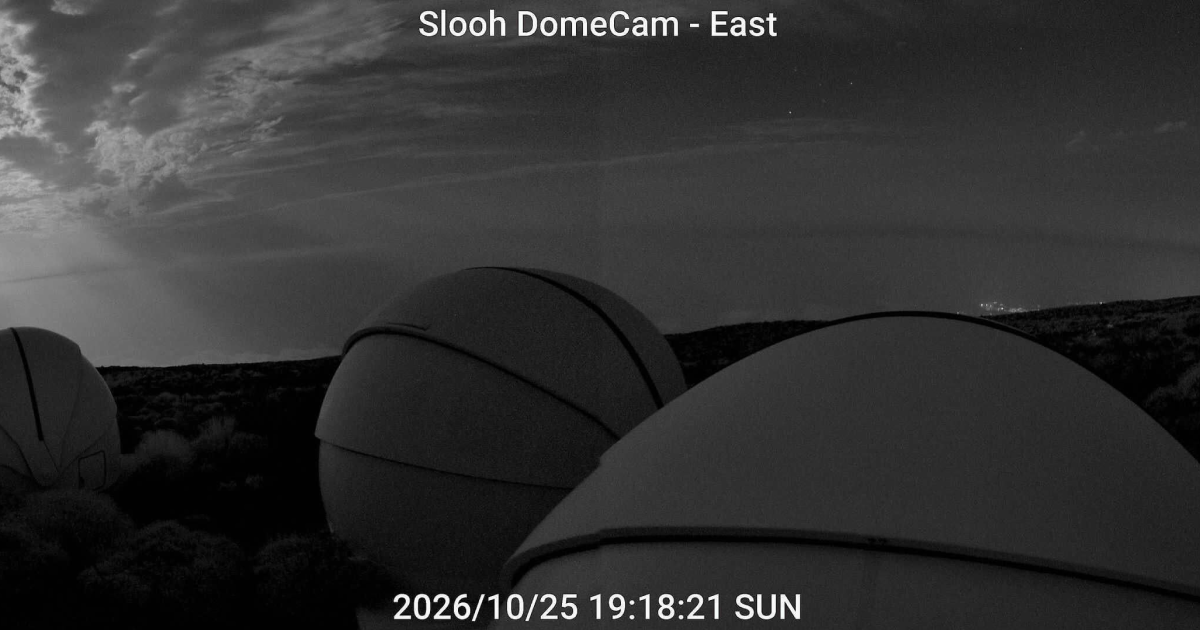
If you’ve been logging in over the past couple of weeks hoping to catch a galaxy or a comet and found the domes shut, you are not imagining it. All three Slooh observatories have spent an unusual amount of the last fortnight closed, and we owe you an explanation rather than a shrug.
The short version: late October is the most difficult stretch of the year for our observatory sites, and this year a very strong El Niño has been stacking the deck against us on top of that. The longer version is below, because we think the sky is more interesting when you understand what it’s doing.
Three observatories, three awkward seasons
Slooh's telescopes sit on three continents precisely so that when one sky closes, another opens. Most of the year that works beautifully. This time of year is the one window where all three sites tend to struggle at once, for different reasons.
Canary Islands Observatory. Summer on Tenerife is the stuff of astronomers' dreams: the trade winds hold a layer of cloud far below the 2,400-metre observatory, and the summit floats above it in dry, still air. As autumn arrives, that pattern breaks down. Atlantic low-pressure systems begin tracking across the islands, bringing cloud and humidity up to the summit, and the first winter storms can arrive with little warning. October is the hinge between the two seasons, and it’s rarely a gentle one.
Chile Observatory. It’s spring in the southern hemisphere, and spring in central Chile means the Pacific is still cold while the land warms quickly. The result is the coastal cloud that Chileans call camanchaca, which rolls inland on many evenings, along with a run of late-season frontal systems. The famously dry Chilean sky really arrives in December and holds through the austral summer.
Australian Observatory. Spring in New South Wales is storm season. Warm, humid air from the north meets cooler air from the south over the Great Dividing Range, and the afternoons and evenings can produce thunderstorms, high winds and the dust that comes with them. Even on nights that clear, gusts and high humidity above our safe operating limit will keep the roof shut.Any one of these on its own would cost us a few nights. This year they’ve lined up.
What El Niño is adding this year
Every few years, the eastern tropical Pacific warms well above normal, and the atmosphere above it rearranges itself in response. That is El Niño, and 2026 is not a modest one. In mid-October the key ocean index stood at +3.3°C above normal and was still climbing; NOAA's Climate Prediction Center puts the odds at 75% that this becomes the strongest El Niño in records going back to 1950.
For our Chilean observatory the connection is direct and well documented. El Niño years bring more frequent and wetter frontal systems to central Chile, and a cloudier, more unsettled spring than usual. The clear nights are still coming, but they are arriving later and less reliably than in an ordinary year.
For Canary and Australia the effect is less direct. A strong El Niño does not so much create weather at those sites as reshuffle the global circulation that governs it: the jet streams shift, storm tracks wander from their usual lanes, and the normal seasonal rhythms become harder to predict. In practice that has meant forecasts we would normally trust for three days ahead changing within hours, and a season that was already unsettled becoming more so.
We should be honest that nobody can point at a single closed dome and say "that was El Niño". What we can say is that we are running three observatories through their hardest few weeks of the year, under a climate pattern that forecasters are describing as historic. The two together explain a run of closures we would otherwise find hard to account for.
Why we close rather than push our luck
A closed dome is frustrating. An open dome in the wrong conditions is far worse. Each observatory runs its own weather station and cloud sensor, and the automation will not open, or will close within seconds, when humidity, wind or precipitation cross the limits we have set. Those limits are conservative on purpose.
The telescopes, cameras and mounts that you control are precision instruments that can take months to replace. A single episode of condensation on optics, or a gust catching an open shutter, can cost us weeks of observing for every night we might have gained. When the sensors say no, the telescopes stay safe inside, and we would rather explain a quiet period than a broken telescope.
What happens next
The good news is that this is a season, not a trend. Canary settles into its winter pattern of long, cold, clear nights. Chile's skies open up as the austral summer takes hold in December and run clear for months. Australia's storm season gives way to calmer, drier conditions through the new year. By late November we expect to be back to the rhythm you are used to, and we will be watching every forecast between now and then.
In the meantime, the telescopes open the moment the weather allows, and they are rarely all closed at once. Check the live status and forecast on each telescope page before you plan an evening, keep your mission queue stocked, and dip into the archive: there are years of member-captured images waiting to be revisited. The sky is not going anywhere, and neither are we.